
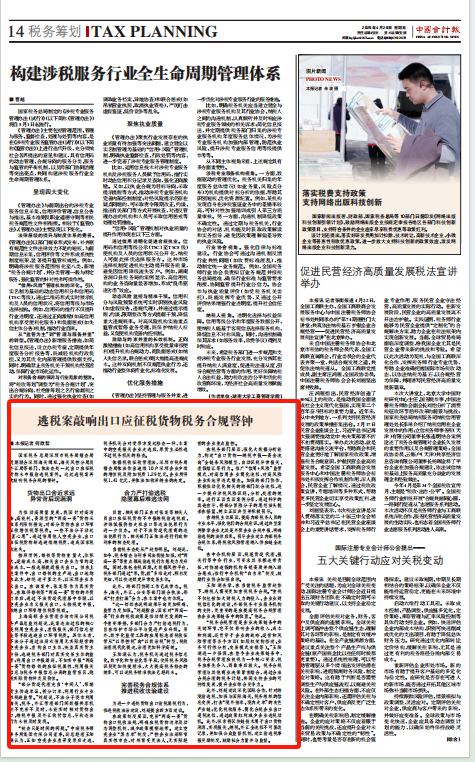
【Dynamic】Wang Yanghu, Director and Deputy General Manager of ChungRui Tax Consulting Group, was interviewed by China Accounting News regarding the tax evasion case and the warning bell it has sounded for tax compliance in the export of taxable goods.
Release time:2025-05-06 Hits:140
The Tax Inspection Bureau of the Shenzhen Taxation Bureau recently joined forces with Shenzhen Customs Anti-smuggling Bureau, Customs Risk Control Division, and the Foreign Exchange Administration to investigate and deal with a tax evasion case involving the unreported export of taxable goods. This tax evasion case once again serves as a warning bell for tax compliance.
Goods Exported by Taking the Long Way Around
Unusual Circumstances Reveal Loopholes
In order to promote high-quality development, China has implemented a series of restrictive measures for high-pollution, high-energy-consuming, and resource-intensive ("two-high-one-resource") goods. Taxes such as value-added tax (VAT) are levied on some goods at the export stage. However, some lawbreakers have come up with "crooked ideas" to export taxable goods and evade taxes, resulting in the loss of national tax revenue.
It is common practice that heavy and bulky goods like ferrochrome, which have high transportation costs, are usually exported through nearby customs to save on transportation costs. However, in the aforementioned case, the production and export locations of ferrochrome were both in the north, but the goods were routed thousands of miles away and exported under the name of a Shenzhen-based company. In this case, Zhang and others, as the actual owners of the goods, obtained foreign trade orders for taxable "two-high-one-resource" goods such as ferrochrome. They then used illegal freight agents to connect with shell companies to export the goods without declaring and paying the VAT and other taxes required at the export stage.
Liu Chao, the director of the tax product division of Shanghai Gaodun Enterprise Management Consulting Co., Ltd., said that the core of the illegal process in this case was the use of shell companies, false customs declarations, and information barriers between departments to evade export taxes. Specifically, the lawbreakers registered or borrowed shell companies without actual operations to fabricate export entities, conceal the identities of the real owners of the goods, and evade the supervision of the tax authorities over the real transaction subjects. They also exploited loopholes in export declarations, failed to truthfully declare the taxable attributes of the "two-high-one-resource" goods such as ferrochrome, and took advantage of the regulatory blind spots where customs information and tax declaration information were not integrated, thereby concealing the actual types and values of the goods.
"Some freight agents acted as 'middlemen,' helping the owners of the goods forge documents and split orders, using their industry expertise to evade supervision," Liu Chao said. The lawbreakers took advantage of the imperfect and untimely data-sharing mechanisms between customs, tax, and foreign exchange management departments, which failed to verify the information on goods exports, tax declarations, and foreign exchange payments in real time. As a result, the illegal activities were not detected in a timely manner.
"It was only a matter of time before they were caught," said Wang Yanghu, director and deputy general manager of ChungRui Tax Consulting Group Co., Ltd. Just as shell companies that issue fake invoices and then disappear will lead to checks on the recipient companies by the tax authorities, in this case, once the shell customs declaration companies disappeared, the original owners of the goods would inevitably face tax inspections.
Joint Efforts to Severely Crack Down on Tax Evasion
Hidden in the Shadows, Yet Unable to Escape the Law
At present, the relevant departments are further investigating Zhang and other individuals for their criminal acts of not declaring and paying taxes on the export of taxable goods, as well as suspected low-price smuggling for export. The illegal activities of the freight agents are also being verified and dealt with through administrative and criminal procedures.
The current trend of strict tax inspections is evident. Liu Chao said that the connection between tax inspections and criminal justice has been strengthened, and the punishment for tax evasion in key areas such as "two-high-one-resource" has been intensified. At the same time, relying on the Golden Tax Phase IV and the big data risk control platform, the tax authorities can quickly identify abnormal transaction subjects through multi-dimensional comparisons of "invoices, goods, and payments." The granularity is finer.
Moreover, cross-departmental collaboration has become the norm. The joint law enforcement by tax, customs, foreign exchange, and public security departments, which is also reflected in this case, has formed a combined force to combat tax fraud and smuggling.
"All of this indicates that the policy orientation is becoming clearer and the regulatory efforts are being strengthened," Liu Chao pointed out. The national tax policy for the "two-high-one-resource" industry is an important measure to promote green development. The combined efforts of multiple departments to severely crack down on tax evasion are aimed at maintaining market fairness and promoting industrial upgrading. In addition, the application of digital regulatory tools marks the transition of tax administration from "invoice-based tax control" to "data-driven tax governance," accelerating the modernization of tax governance and making it more scientific and efficient.
Wang Yanghu believes that through the informatization, digitalization, and intelligence of tax authorities, tax risk identification has become faster and more accurate, greatly improving the efficiency of tax inspections. It can be said that precise tax enforcement has arrived.
Improving the Tax Compliance System
Promoting the Construction of Tax Rule of Law
To further curb tax evasion in goods exports and promote the construction of tax rule of law, Liu Chao proposed suggestions in four areas.
At the policy level, it is necessary to improve the export tax regulations for "two-high-one-resource" goods, clarify the list of taxable goods and a dynamic adjustment mechanism, and reduce policy ambiguities. A "blacklist" system for shell companies should be established to strictly control the authenticity review at the enterprise registration stage and closely monitor enterprises that frequently change legal representatives or have no actual operations.
At the tax department level, it is important to enhance the ability to analyze big data and build a full-chain risk model for "export goods—tax declaration—funds flow" to automatically identify abnormal customs declarations and false remittances. The "credit + risk" regulatory model should be promoted to simplify procedures for high-credit enterprises and conduct penetrating inspections for high-risk enterprises. Cross-departmental cooperation should be strengthened to actively optimize related cross-departmental cooperation processes and further improve the efficiency of identifying, analyzing, and handling tax risks. Positive and negative case studies should be shared, and through scientific public opinion guidance, the adventurous thoughts of some individuals should be nipped in the bud. Positive examples should be established and actively guided.
At the taxpayer level, it is necessary to improve the professional level of internal tax personnel, enhance their compliance awareness, and use typical cases to warn enterprises, especially foreign trade enterprises, to declare taxes in compliance and clarify the legal consequences of tax evasion. Enterprises should be guided to establish internal tax compliance systems and integrate tax risk management into the entire supply chain.
At the intermediary level, the freight forwarding and customs brokerage industries should be regulated. They could be required to bear joint liability, and those assisting in fraud should have their qualifications revoked and be included in joint punishment. A "whitelist" system for intermediaries should be promoted to encourage industry associations to strengthen self-discipline.
Wang Yanghu said that under the current tax supervision trend, taxpayers need to pay more attention to tax compliance. "Attention not only includes increasing investment in tax and finance personnel, the construction of enterprise business, tax, and finance informatization, and the support of external tax professional service institutions, but more importantly, it is necessary to increase the position of tax compliance management in the enterprise decision-making chain." He said.
"Tax compliance management is a key link in the enterprise decision-making chain. It not only affects the income, costs, and profits of enterprises but also runs through all aspects of the enterprise's strategy, operations, and risk management (such as equity structure building, business feasibility analysis, transaction model arrangement, etc.)," Wang Yanghu further emphasized. In the entire enterprise decision-making chain, tax compliance management should be regarded as a core element, and taxes should be involved in advance rather than being a last-minute solution. Tax compliance management should be closely integrated with other business decisions. Through legal, compliant, and reasonable tax planning, it can jointly support the sustainable development of enterprises and enhance their overall competitiveness.
In addition, Liu Chao suggested deepening international cooperation to combat cross-border tax evasion by strengthening information exchanges with international customs and tax organizations and cracking down on the gray industry chain of "overseas order-taking and domestic order-routing." The export tax rebate process for compliant enterprises should be simplified through policy dividends to reduce the motivation for tax evasion. In addition, the use of blockchain technology to trace the origin of exported goods should be explored to achieve tamper-proof records for the entire process of customs declaration, tax payment, and foreign exchange. The public supervision mechanism should also be strengthened by establishing a reward system for reporting tax evasion and encouraging social forces to participate in supervision.



 Room 1601, Tower A, Fenglan Intemational Center, Xizhimen North Street No.32, Haidian District, Beiing, P.R.China
 WeChat account